
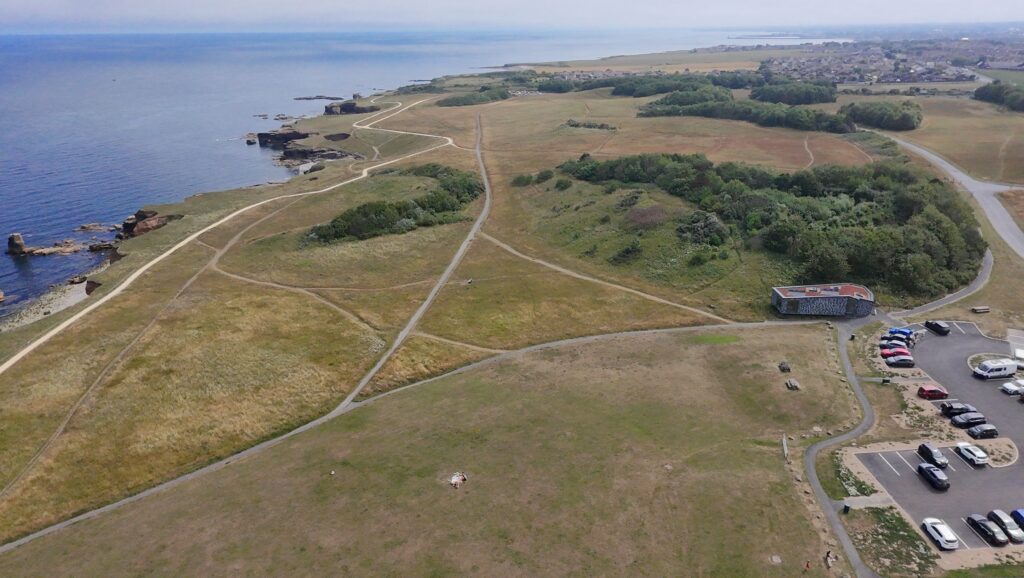
This route is the “Cradle of Civilization” loop, a roughly 23-mile (37km) odyssey that bridges two millennia of North East history. From the monastic peace of the 7th century to the cutting-edge architecture of the 21st, this run is a flat, fast, and culturally dense journey through the heart of the Tyneside corridor.
Location & Setting
Starting at Temple Park in South Shields, you are positioned on what was once the outer fringes of the Roman Empire. This route is a geographical “double-cross” of the River Tyne, utilizing the world’s first purpose-built pedestrian tunnel and the world’s first tilting bridge. You’ll be tracking the footsteps of the Romans, the monks of the Dark Ages, and the industrial titans who built the world’s greatest ships.
Phase 1: The Monastic Gateway (Temple Park to Jarrow)
The run begins around the green expanse of Temple Park, a reclaimed space that serves as the “lungs” of South Shields.
- Tyne Dock & Jarrow Road: The first few miles are a straight, paved “warm-up” along the industrial artery of Jarrow Road. The terrain is flat, allowing you to settle into a steady rhythm.
- St. Paul’s Monastery: As you reach Jarrow, you pass St. Paul’s Church and Monastery. This is hallowed ground. In the 7th and 8th centuries, this was the home of the Venerable Bede, the “Father of English History.” Running past these stone walls, which have stood for over 1,300 years, provides a humbling sense of perspective before you dive into the industrial heart of the river.
Phase 2: The Subterranean Crossing (The Tyne Pedestrian Tunnel)
Leaving Jarrow, you approach one of the most unique “runner’s experiences” in the UK: the Tyne Pedestrian and Cycle Tunnel.
- The Descent: Opened in 1951 as part of the Festival of Britain, this tunnel sits 12 meters below the river bed.
- Terrain: The descent (and subsequent ascent) via the tiled escalators or lifts is a brief moment of recovery. The tunnel itself is a 270-meter dash through a gleaming, tiled time capsule. The air is cool, the acoustics are echoing, and the flat, smooth surface makes for a surreal, high-speed sprint beneath the massive vessels docked above
Phase 3: The Northern Shore (Wallsend to St. Peter’s)
Emerging on the North side in Howdon/Wallsend, you join Hadrian’s Way (part of National Cycle Route 72).
- Segedunum & Wallsend: You are now running on the eastern terminus of Hadrian’s Wall. You’ll pass the Segedunum Roman Fort, where the “Wall” officially ended. The terrain here is a mix of dedicated cycle paths and reclaimed railway lines.
- The Industrial Echo: As you head west toward Newcastle, you pass the former sites of the great Swan Hunter shipyards. The landscape is a blend of modern housing and massive, rusting cranes—a reminder of the river’s “Heavy Metal” heritage.
- St. Peter’s Marina: The path softens as you reach St. Peter’s Basin. This sheltered marina feels miles away from the city, with yachts bobbing in the water and a sudden shift to manicured, quiet riverside trails.
Phase 4: The Quayside & The Millennium Bridge
The route reaches its aesthetic peak as you enter the Newcastle-Gateshead Quayside
- The Bridge Vista: The landscape opens up into a “Cathedral of Engineering.” You’ll pass the Byker Wall, Tyne Bridge, the Swing Bridge, and the High Level Bridge.
- Millennium Bridge: You’ll cross the river via the Gateshead Millennium Bridge (the “Blinking Eye”). This award-winning tilt bridge provides a perfect mid-run photo opportunity, with the Glasshouse (Sage) and BALTIC Centre for Contemporary Art towering over the south bank.
- Terrain: This is the busiest part of the route. Expect flat, paved promenades and plenty of “pedestrian slalom” as you navigate the crowds.
Phase 5: The Keelman’s Way (Heading East)
Once on the south bank, you join the Keelman’s Way, a long-distance path named after the men who once navigated the coal-laden “keels” (shallow-draft boats) along the Tyne.
- Gateshead to Hebburn: This section is a runner’s delight. It is a dedicated, traffic-free corridor that hugs the riverbank. The landscape becomes greener and more secluded as you leave the city behind.
- Terrain: The path is predominantly flat, tarmac, and sheltered by trees, protecting you from the North Sea winds.
- Jarrow Riverside: You’ll pass back through the southern side of Jarrow, catching glimpses of the Port of Tyne and the massive car terminals. The contrast between the natural riverside beauty and the raw power of the working port is striking.
Phase 6: The Return to Temple Park
The final leg requires you to leave the river and head inland for the finish
- Tyne Dock & The Final Incline: From the riverside, you retrace your steps toward Tyne Dock. This is the only section where you’ll face a noticeable “false flat”—a gradual, grinding ascent back toward the elevation of South Shields.
- Temple Park Finish: Entering the park from the Jarrow side, you have wide, grassy verges or paved loop paths to finish your session. After 17 miles of tarmac and history, the soft grass of the park is a welcome relief for tired legs..
Route Statistics & Technical Terrain
Total Distance~17.5 Miles (28km)
Surface: 95% Paved (Cycle paths, promenades, road-side)
Total Ascent: Minimal (~60m). The route is almost entirely flat, following the river basin.
Historic Highlights: St. Paul’s Monastery, The Pedestrian Tunnel, Segedunum, and Millennium Bridge.
The Runner’s Experience
This is a “rhythm” run. Because it is so flat, it is perfect for marathon pace work or a long, steady Sunday miles. The psychological boost of crossing the river twice—once underground and once over an architectural marvel—breaks the distance into manageable chunks.
The biggest challenge isn’t the elevation; it’s the exposure. The Tyne valley can act as a wind tunnel, so be prepared for a headwind either on the Wallsend stretch or the return along the Keelman’s Way.
This is a phenomenal route for seeing the best of Tyneside.

@run.and.trail6 A journey through history, running under the River Tyne through the famous Pedestrian Tunnel. Built to allow the shipyard workers from South of the river easier access to the shipyards of the North.
♬ Epic Motivation – Luxury Insvira
Leave a Reply