
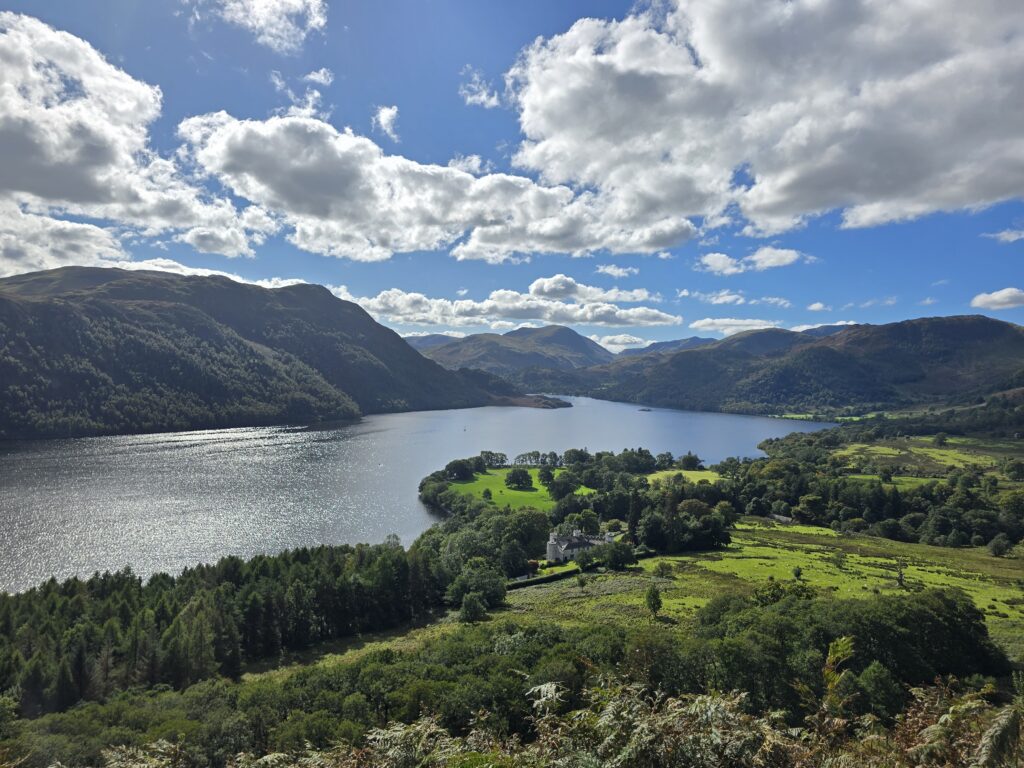
At the end of the summer a few years ago, I spent my time supporting two open water swim events in the beautiful setting of the English Lake District. Or that was the plan! Below you can see a beautiful, calm and tranquil Ullswater, the night before.

In the role of safety Kayaker and open water Lifeguard, I planned to spend my Saturday and Sunday paddling two of the most beautiful lakes in the UK, Ullswater and Windermere.
There are many aspects of these events which cross over ibetwen both professional and personal lives; people, planning, collaboration, communication, patience, focus to mention a few.
Each of these events, the Ullswater Chill Swim (around 7 miles) and the Windermere One Way (around 11 miles), from the perspective of the swimmer and myself as a safety kayaker / lifeguard are quite different and require a varied approach.
Ullswater
Lets begin with the Chill Swim, a mass participation event with around 250 swimmers, groups of swimmers start at various time intervals, with between 20 and 60 swimmers in each wave. Now traditionally, as this is an ‘end to end’ event, a team of safety kayakers (around 6 – 8 paddlers) are assigned a wave and follow that wave through out their swim.

This year the weather had different ideas, with gusts of 35mph plus; for safety reasons, the decision was taken to restructure the event and create a 1 mile loop course at the East end of Ullswater where it was more sheltered.
You can see in the photo (it doesn’t do the conditions justice), the lake was no longer calm and tranquil but had transformed in to a ‘seascape’ with white topped waves (swelling at around 2ft).
In this scenario, the course is split in to ‘zones’ with kayak teams assigned a zone to cover. In order to prevent distraction and to keep the kayakers ‘moving’, each team rotates through the zones every 30 – 40 minutes.
Planning
As a kayak team, we need to communicate from the outset, before we even get our feet wet. Coordinating, roles and responsibilities, positioning within our zone, how we intent to communicate out on the water (it’s difficult enough in calm conditions to communicate over 50 – 200 plus people out on the water, without 35mph gusting winds).
Execution
Once on the water, kayak team members are continiously in communcation with each other, through hand signals, shouting over distance and radio communication. Along with communications with the wider safety teams, land based and water based (power baot rescue teams). Following agreed protocals and processes outlined in the pre event briefings and team briefings is essential to the success (and safety of everyone involved) of the event.
Within the execution of any team activity, communication and following agreed processes within activity build up and delivery is a pivotal component to activity success and safety. Lack of communication or disjointed, adhoc and disconnected communication only adds to the potential for confusion, uninformed decision making and unplanned consiquences.
Review
At the end of each ‘phase’ as the kayak team transitions to the next ‘zone’, we always discuss the last phase, what worked, what didnt and how can we approach the next phase to ensure it is as successful or even better than tha last. In project terms, we review leasons learned and adjust our approach to the next project in order to improve and learn from experience.
People
For all of this to work, the key to success is people. Having the right people in the right role is imperative, everyone within the team muct be clear as to thier role and the expectations on them. Knowing what is expected of you helps nurcher confidence and clarity, people perform at thier best when they are clear about what they need to do, and feel their team are confident in them. Back to the ‘Planning’ piece, plan the team as well as the project.
Windermere
The Windermere One Way is an annual swim in which around 300 swimmers take on the challenge of swimming the full length of the lake. A both physical and mental challenge for bith swimmer and rescue kayaker, as they are both in the water between 6 and 10 hours, each swimmer is allocated a support kayaker who is responsible for supporting the swimmer, navigating the length of the lake and keeping the swimmer on track, safe from the multitude of commercial and private pleasure craft, a chain pulled car ferry, the cold, cramps and carrying their sustenance.
Paddlers are given guidance as to the route swimmers must take along their journey, usually headland to headland navigation along the lake, but the more accurate a paddler navigates, the less distance their swimmer ends up swimming to reach their goal of swimming the full length of Windermere (around 11 miles).
That year, Windermere didn’t quite turn out as planned. Due to the continued stormy weather, the organisers made the hard, but certainly correct decision, to call off the event for the year. For the safety of all involved, swimmers, kayakers and other safety personnel, it was just too dangerous.

I have shared the experience of Windermere with a number of swimmers as they have tackled the demanding journey to conquer its waters.
Leave a Reply